
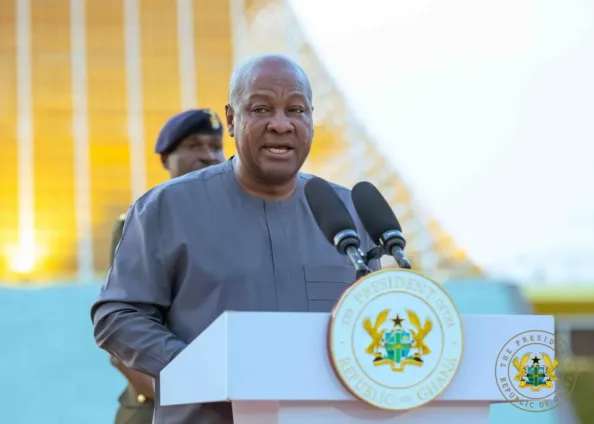
President John Dramani Mahama’s job approval rating has climbed to a historic 71%, up four percentage points from March, according to the June 2026 National Tracking Poll released by Global InfoAnalytics on Sunday.
The polling firm noted that this figure represents the highest approval rating recorded for any sitting president since its regular tracking series began in 2020.
Only 23% of respondents disapprove of the President’s performance, while 6% expressed no opinion.
This surging approval mirrors a broader sense of national optimism.
According to the data, 66% of Ghanaians believe the country is headed in the right direction—a figure holding steady from the March wave—while only 27% feel it is on the wrong track.
Furthermore, 57% of respondents reported that their standard of living has improved over the past year, and 68% expect further improvements over the next 12 months.
The Partisan and Regional Divide
While the overall numbers paint a strong picture for the administration, the data reveals deep regional and partisan cleavages.
Predictably, support splits sharply along party lines: 91% of National Democratic Congress (NDC) supporters approve of the President’s performance, compared to just 37% of New Patriotic Party (NPP) sympathisers.
Crucially for future electoral math, Mahama maintains a solid grip on unaligned voters, securing a 65% approval rating among floating voters.
Geographically, the President enjoys his strongest support in the Savannah (86%) and Western North Carolina (82%) regions. Conversely, the Ahafo region returned the lowest approval at 40%, followed closely by traditional opposition strongholds like the North East (52%) and Ashanti (55%) regions.
Economic Blindspots and Corruption
Despite broad satisfaction with the government’s direction—with 69% rating general government performance as either good, very good, or excellent—Ghanaians highlighted critical pain points.
Unemployment remains the public’s primary grievance, with 44% labelling it as the government’s poorest-performing area.
This was followed by management of the general economy (32%) and persistent electricity supply challenges, known locally as dumsor (29%).
On the governance front, 54% of respondents believe the state of corruption has improved over the last year.
When asked which institution is best equipped to lead the anti-graft fight, a 36% plurality said the Attorney General (AG) and the Office of the Special Prosecutor (OSP) are equally capable.
Among those who favoured a single entity, the AG led the OSP 24% to 16%.
Shifting Views on Discipline and Age
The June poll also captured evolving public sentiment on social issues and the future of Ghanaian leadership.
A clear 67% majority of Ghanaians favour publicly publishing the photographs of adults caught engaging in examination malpractice.
When it comes to handling school indiscipline, a 38% plurality supports the reintroduction of corporal punishment, which outstripped public support for suspension at 27% and community service at 20%.
On the political front, a strong majority of Ghanaians (57%) expressed a distinct preference for younger leadership going forward.
This youth-centric sentiment was highest in the Savannah (89%) and Upper West (82%) regions, though it failed to win over majorities in the Ashanti, Bono, and Western North regions.
When pushed on what age constitutes “too old” to lead, nearly half of the country (46%) pegged the threshold at 65 and above, 17% set it between 50 and 54, while 21% maintained that age is entirely irrelevant.
Methodology
The Global InfoAnalytics survey was conducted between 30th May and 12th June 2026, sampling 8,784 voters across all 16 regions and 84 constituencies.
The hybrid study utilised face-to-face interviews for 7,484 respondents alongside 1,302 online responses.
The poll operates at a 99% confidence level with a margin of error of ±2.5%.