
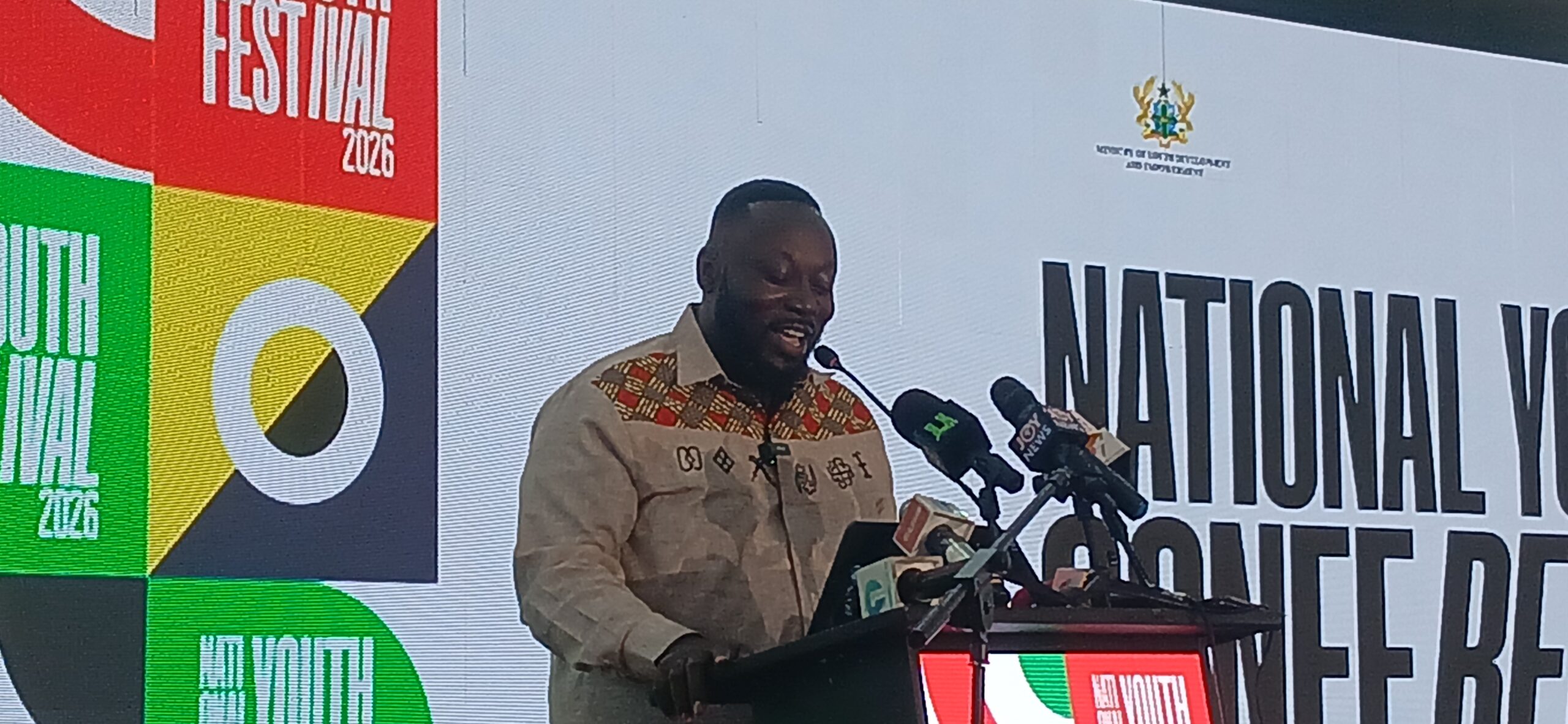
Minister for Youth Development and Empowerment, Hon. George Opare Addo, has disclosed that the government will be redirecting a significant majority of national service personnel into the private sector under a new retention agreement aimed at directly bridging the gap between education and employment.
Under the upcoming Graduates in Corporate Support (GRICS) programme, private sector organisations partnering with the state will be required to sign Memorandums of Understanding (MOUs) guaranteeing the permanent employment or retention of at least 60 per cent of the service personnel deployed to them.
The Minister disclosed this while speaking at the National Youth Conference organised by the National Youth Authority (NYA) under the theme, “Rebuilding Values, Inspiring Patriotism: Empowering the Youth in the Digital Age” held at the Great Hall of the Kwame Nkrumah University of Science and Technology (KNUST).
Addressing the gathering, Mr Opare Addo explained that public sector agencies are heavily congested, with data revealing that graduates posted to government institutions spend between four and 10 years searching for permanent jobs post-service, compared to one to three years in the private sector.
”In the coming days, a lot of our service personnel will not be posted to the government sector anymore,” Mr Opare Addo stated, adding, “We intend to push many more into the private sector where the real jobs exist…”
”The MOUs we are signing with these organisations guarantee that anytime we give you personnel, you employ or retain a minimum of 60 per cent of those given to you,” he further stated.
Mr Opare Addo highlighted that the policy shift forms part of a broader structural overhaul by the Ministry and its sub-agencies, including the National Youth Authority, the Youth Employment Agency (YEA), and the National Entrepreneurship and Innovation Programme (NEIP), to ensure skill acquisition directly aligns with market demand.
Alongside the GRICS initiative, the Minister stated that the government is expanding the National Apprenticeship Programme to support Senior High School (SHS) graduates who do not transition to tertiary education, a group accounting for roughly 6 to 7 out of every 10 Free SHS graduates.
Highlighting a community-based master-apprentice model tailored to regional economies, Mr Opare Addo stated that the programme ensures participants secure livelihoods locally without having to migrate to major urban hubs like Accra or Kumasi.
At the international level, he stated that the YEA is managing a new Global Labour Exchange Programme to facilitate the structured, dignified export of skilled young Ghanaian workers to foreign markets in Europe, Asia, and the Americas facing labour shortages due to ageing populations.
Additionally, he said the YEA plans to roll out a Domestic Care Economy initiative next year aimed at replacing temporary community protection roles with a standardised, sustainable workforce.
The Minister stressed that state action alone is insufficient to resolve youth unemployment, calling for active backing from financial institutions, universities, and private employers.
Have a news tip or a correction regarding this story? Reach out to our editorial desk at newshubgh2026@gmail.com or contact us on 0245975627.