

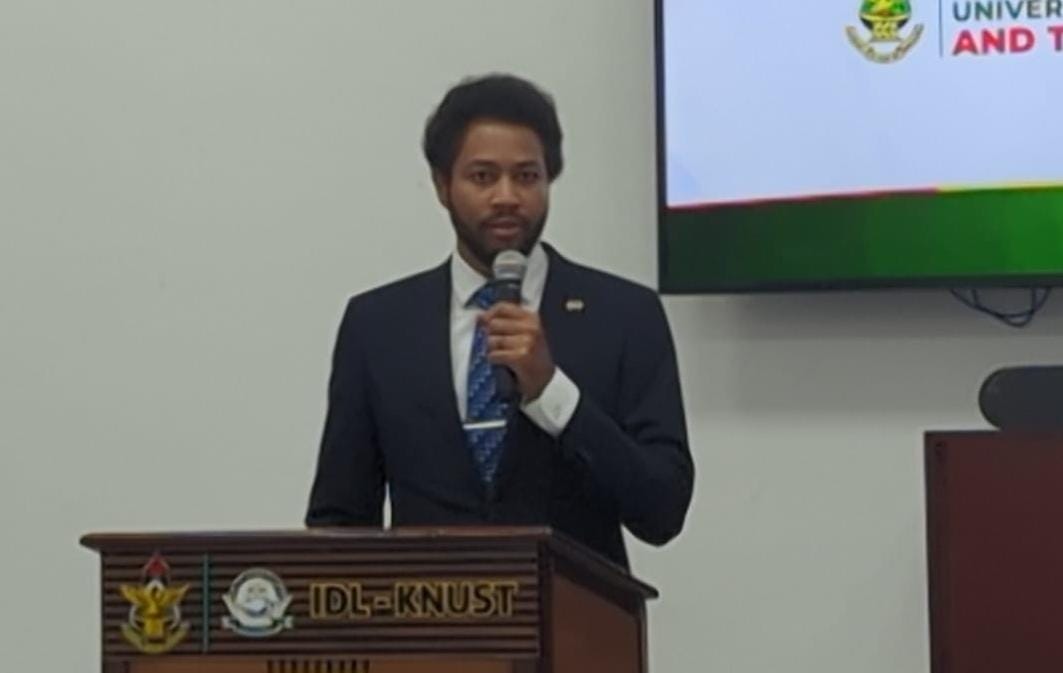
Czech Ambassador to Ghana, Pavel Bílek, has highlighted community and regional media broadcasting in local languages as the primary line of defence in making cybersecurity accessible to ordinary citizens.
His message was delivered by the Deputy Ambassador, Nick Ojo Omorodion, at the opening of the Kumasi edition of the National Community Media Cyber Capacity Building Project (NCMCCBP) today at the Kwame Nkrumah University of Science and Technology (KNUST).
”Community and regional media understand the daily realities of the people they serve,” Ambassador Bílek stated, adding, “They communicate in local languages and can translate complex cyber threats into clear and practical advice.”
The training workshop, organised by the Africa Centre for Digital Transformation in collaboration with the Cyber Security Authority (CSA) and financed by Czechia’s Transformation Cooperation Programme, marks the expansion of the initiative from Accra into the region.
The programme equips journalists with practical skills to identify cyber threats, counter online fraud and misinformation, protect newsroom sources, and report accurately on digital crimes.
Ambassador Bílek noted that cybersecurity awareness cannot remain concentrated within specialised institutions or the capital, emphasising the direct protective impact of localised news.
”One accurate report can prevent a person from becoming a victim of fraud,” he stated, highlighting, “Each of you can carry that knowledge further through your newsroom, your radio station, your language, and your community.”
Financed by the Czech Republic through its Transformation Cooperation Programme, he said, the project complements broader bilateral support between Czechia and Ghanaian law enforcement agencies to strengthen national digital defence.
For his part, Prof. Caleb Kesse Firempong, who deputised for the Vice-Chancellor of KNUST, said cybersecurity has evolved from an IT-exclusive concern into a collective responsibility for anyone using a mobile phone, accessing the internet, or conducting digital transactions.
”Ghana’s digital transformation continues to create enormous opportunities for individuals, businesses, institutions, and communities,” he stated, adding, “However, alongside these opportunities come increasingly sophisticated cyber threats. Cybersecurity has consequently become a shared responsibility.”
Highlighting the pivotal role of local journalism, he emphasised that community media serves as an essential bridge connecting specialised cybersecurity institutions with the public at the grassroots level.
”Community media, in particular, has a unique ability to reach people at the grassroots level, communicate in accessible ways, and address issues that directly affect local communities,” he said.
“When media practitioners are equipped with the right cybersecurity knowledge, they are better positioned not only to protect themselves and their organisations, but also to educate the public about emerging cyber threats and responsible digital practices,” he further stated.
Have a news tip or a correction regarding this story? Reach out to our editorial desk at newshubgh2026@gmail.com or contact us on 0245975627.