
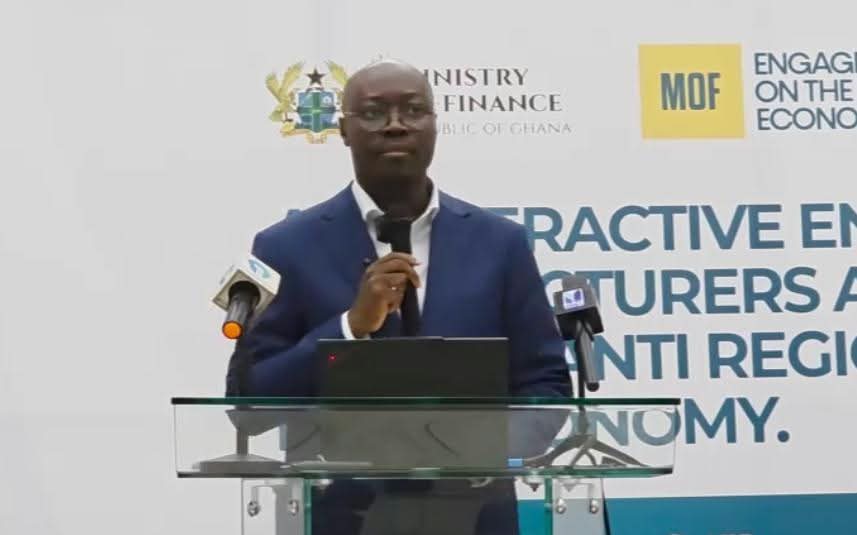
Minister for Finance, Dr Cassiel Ato Forson, has said the incoming “new economy” programme will be funded through a $10 billion internal revenue strategy rather than expanding national debt or relying on central bank money printing.
Speaking at the Kwame Nkrumah University of Science and Technology (KNUST) today, ahead of the government’s formal economic announcement scheduled for Thursday, the Finance Minister detailed a non-debt financing model funded by a combination of new revenue measures and a calibrated adjustment of the country’s fiscal targets.
He emphasised: “GoldBod do not generate money for the Ministry of Finance or the government of Ghana,” but rather “the government of Ghana’s money is generated through taxes, your taxes, and non-tax revenue.”
”We are not adding to the debt. We will maintain the debt anchor of 45 per cent of GDP by 2035,” Dr Ato Forson told the gathering, adding, “And so it is not that we are borrowing to fund a programme, but we are using our own resources within to fund government programme.”
He stated that the economic plan will allocate 1.5 per cent of Gross Domestic Product (GDP) annually from 2027 through December 2030 to underwrite the new measures.
”We are funding it first through 0.5 per cent of GDP of revenue measures, and 1 per cent of lowering the fiscal space from a surplus of 1.5 per cent of GDP to 0.5 per cent of GDP,” the Minister outlined.
He added: “So put together, I’m spending 1.5 per cent of GDP annually from 2027 to December 2030. That gives me a conservative $10 billion equivalent in cedis. Again, that is very conservative. That amount can increase to at least $13 billion.”
He stated that the shift in fiscal targets follows two consecutive years of aggressive debt reduction.
Ghana, Dr Ato Forson said, recorded a primary surplus of 2.5 per cent of GDP in 2025 and is projected to reach 1.5 per cent in 2026, cumulatively reducing public debt by approximately 4 per cent of GDP over two years.
”Next year, we are reducing the fiscal deficit, the primary surplus from 1.5 per cent of GDP to 0.5 per cent of GDP,” the Minister explained, stating, “This pace, or the speed of reduction of public debt by 1.5 per cent and 3.5 per cent of GDP, will now become 0.5 per cent of GDP, or we will be reducing our debt from 2027, 2028, 2029, and 2030 by 0.5 per cent of GDP annually. So the resources are gathering to support the new economy.”
The Minister ruled out monetary expansion, noting that “since we took office, the central bank has not printed a pesewa to support government finances,” and affirming that “the central bank must perform its role, and if government needs money and you want to borrow, should go to the capital market to borrow appropriately.”
Addressing questions from academic staff regarding the economic paradigm, the Minister noted that Ghana’s core strength lies in agriculture, but pointed out systemic challenges: “We need to understand why commercial agriculture is not surviving in Ghana and what are the areas that the Government of Ghana can go into.”
He said the government has identified palm oil, sugar, and poultry as key focus sectors, aiming to reverse heavy reliance on imports.
“We import palm oil into this country. We import palm oil from, in some cases, Côte d’Ivoire, and in some cases from all the way in Malaysia to our country,” the Minister observed.
To fix these structural bottlenecks, he said, the government plans to establish state-backed land banks and extend concessionary capital to mitigate long gestation periods.
“A private company that wants to go into Palm plantation cannot litigate over land, so the government of Ghana will have to spend money to acquire this land from the owners of the land through that bank and lease it to its companies,” the Minister stated, adding that scaling palm production to 100,000 hectares could yield “300,000 jobs direct and indirect are possible too… that will give you about 500,000 jobs.”
In the pharmaceutical sector, where about 75 per cent of consumed drugs are imported and only 25 per cent are produced locally, he stated that the government intends to utilise public procurement to drive industrialisation.
“You can announce a procurement measure to ensure that if you come here and establish your pharmaceutical industry, we’ll be the one that we buy from. That alone can be a shift,” the Minister asserted.
Outlining the broader state policy, the Minister stated: “Our position is simple: Government can lend money to the private sector so that the private sector will be the one to do that business and pay back that money to the state, but not government itself managing that industry. Government is going to enable, but government will not be the one to run these kinds of businesses.”
Dr Ato Forson stated that the complete policy framework will be formally presented during an upcoming address on Thursday, which the Minister noted “will be revealing.”
Have a news tip or a correction regarding this story? Reach out to our editorial desk at newshubgh2026@gmail.com or contact us on 0245975627.