
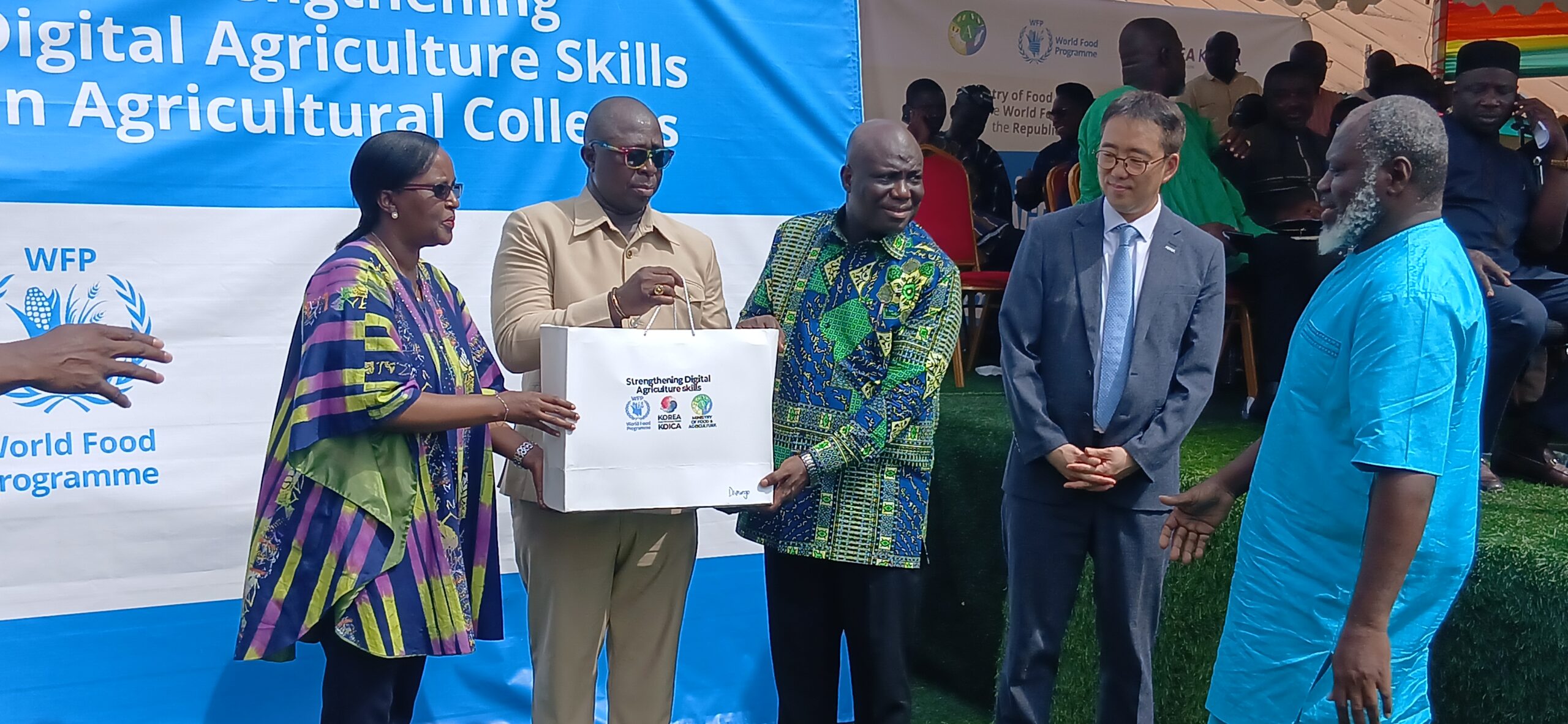
The World Food Programme (WFP), with funding support from the Republic of Korea through the Korea International Cooperation Agency (KOICA), has handed over state-of-the-art agricultural technology equipment worth over $500,000 to five agricultural colleges across Ghana.
The beneficiary institutions — Kwadaso, Wenchi, Ejura, Damongo, and Ohawu Agricultural Colleges — received the equipment through the Ministry of Food and Agriculture (MoFA) to modernise training curricula and strengthen digital agriculture extension services nationwide.
The package includes 15 mini-drones, soil testers, moisture meters, automated weather stations, GPS devices, Internet of Things (IoT) sensor kits, and greenhouse environmental control learning kits.
It also features high-performance computers, business laptops, and specialised software for drone flight simulation, spraying simulation, and spatial data processing.
Speaking at the handing-over ceremony held at the Kwadaso Agric College today, the Minister for Food and Agriculture, Hon. Eric Opoku, described the initiative as a strategic shift toward data-informed and technology-driven farming in Ghana.
”What we are witnessing today goes beyond the handover of agricultural equipment. It represents an investment in knowledge, skills, innovation, and, most importantly, in the young men and women who will shape the future of Ghana’s agriculture,” Mr Opoku said, adding, “We cannot address the agricultural challenges of today using only tools and approaches of yesterday.”
The Minister highlighted the crucial role of the beneficiary colleges, noting that their graduates serve as frontline extension officers interfacing directly with smallholder farmers.
By training students on precision tools to evaluate soil conditions, track weather patterns, and manage moisture levels, the initiative will enhance the capacity of the country’s entire agricultural extension pipeline.
Beyond hardware procurement, the programme encompasses capacity-building workshops for instructors, the modernisation of course curricula, and the integration of digital modules into teaching methodologies to guarantee long-term institutional sustainability.
Mr Opoku commended the broader developmental contributions of WFP and KOICA in Ghana, citing complementary projects in post-harvest management, climate resilience, and local manufacturing.
Under the Local Fabricators Post-Harvest Equipment Programme, implemented in partnership with the GRATIS Foundation, 231 young artisans have fabricated 300 threshers — 200 for maize and 100 for soybeans — to curb post-harvest losses and strengthen local engineering capacity.
Furthermore, through the Changing Lives Transformation Fund, over 10,000 smallholder farmers across 17 districts in the Bono, Bono East, and Savannah regions are receiving training in climate-smart practices.
The initiative has also distributed more than 1.2 million cashew, mango, and moringa seedlings to foster carbon market integration.
Urging principals, tutors, and students to maximise the equipment’s utility, the Minister stressed: “The real measure of success will be reflected in how effectively our instructors use these technologies in teaching, how confidently our students apply new skills, and ultimately how these investments contribute to a more productive, competitive, and resilient agricultural sector.”
WFP Country Director, Aurore Rusiga, underscored that deploying digital innovation is essential to addressing persistent national challenges, including food insecurity, climate variability, declining soil health, and post-harvest losses.
”At WFP, our interest in digital agriculture starts with a much bigger question: How can we build food systems that work better for everyone?” Rusiga said, highlighting, “Technology alone is not enough. Realising this potential requires people with the knowledge and skills to apply them effectively in real agricultural settings.”
She added that agricultural colleges remain the primary gateway for training extension workers and technicians who support rural smallholders, making curriculum integration essential for nationwide impact.
Reinforcing KOICA’s commitment to human capital development, KOICA Ghana Country Director, Mr Dong Wan Woo, stated that rapid shifts in global agriculture require young professionals to acquire hands-on technical competencies alongside traditional academic knowledge.
”Agriculture is changing rapidly, and technology is becoming more important in how farmers access information, manage risks, and make decisions,” Mr Woo said.
“Young agricultural professionals therefore need not only classroom knowledge, but also practical experience with modern technologies,” he added.
Have a news tip or a correction regarding this story? Reach out to our editorial desk at newshubgh2026@gmail.com or contact us on 0245975627.