

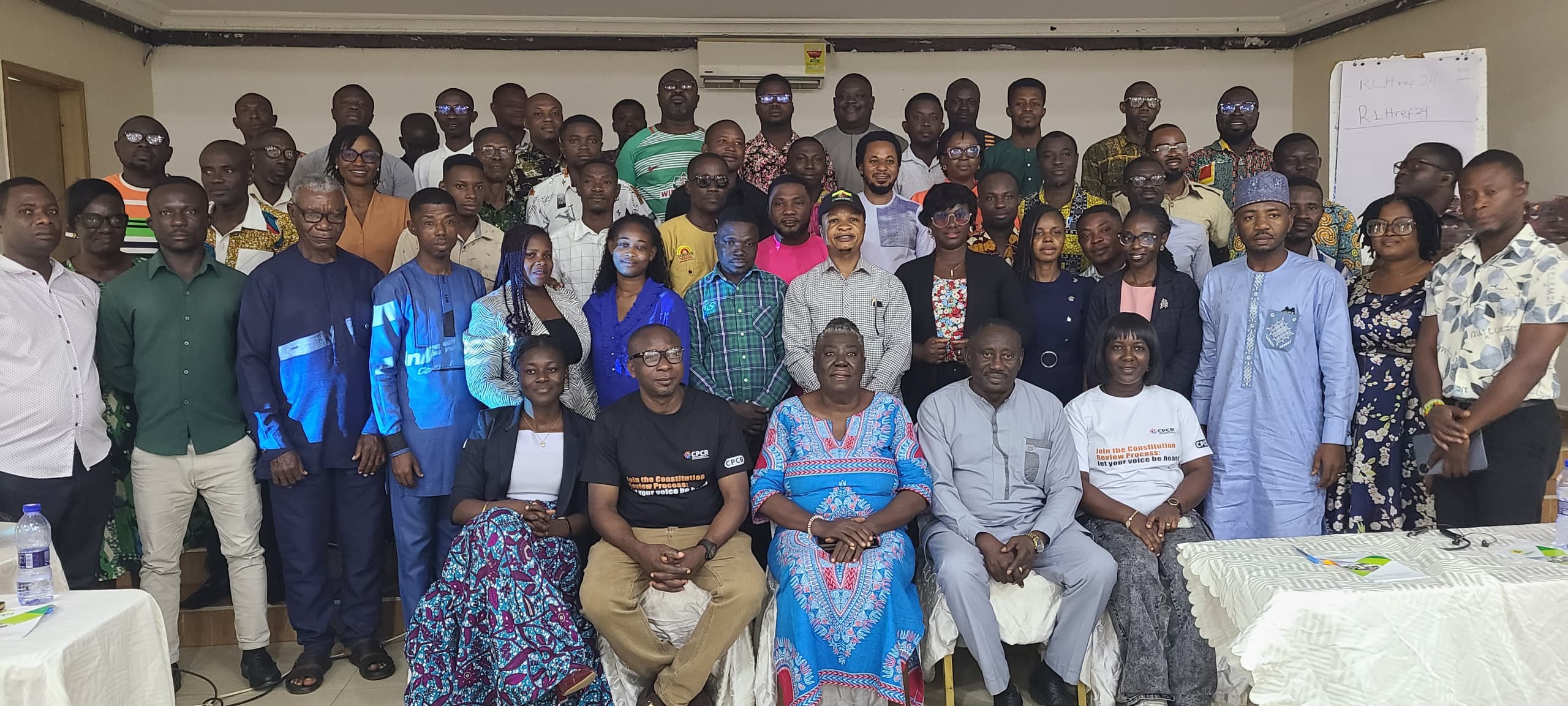
The Citizens Platform and civil society organisations have called for a legally binding framework to protect the nation’s constitutional reform process from political interference and administrative disruptions caused by changes in government.
Speaking in Kumasi at a workshop for selected journalists on the Constitutional Review Commission recommendations, the Government Position Paper, and CSO submissions, Ms Victoria Asumin, Ashanti Regional Coordinator for Amnesty International and executive member of the Citizens Platform, emphasised that the continuity of the reform process must be guaranteed.
”The Citizens Platform is advocating for a legally binding framework that allows the reform process to continue regardless of changes in government or parliament,” Ms Asumin stated.
She warned that without a structured legal shield, the national effort risks losing momentum, facing interruptions, or forcing successive administrations to restart the process from scratch.
Beyond legal safeguards, Ms Asumin highlighted civic education as a prerequisite for meaningful public participation, warning that constitutional reform cannot succeed if citizens are left in the dark.
”How can citizens own a constitutional reform process if they do not understand the proposals? How can people participate in it if they do not know what is at stake?” she asked, calling on the government to ensure dedicated and sustained funding for civic education nationwide.
She stressed that awareness campaigns must extend beyond urban centres like Accra to reach rural communities, women, and marginalised groups with limited access to traditional and digital media.
Addressing gender inclusion in governance, Ms Asumin revealed that the Affirmative Action Coalition, in collaboration with other women’s rights organisations, is preparing a position paper to advocate for proportional representation and the constitutional entrenchment of gender quotas.
She noted that the current reform debate presents a critical window to fix long-standing gaps in women’s political representation across decision-making institutions.
While acknowledging that various groups, including the New Patriotic Party (NPP), civil society organisations, youth groups, and persons with disabilities, have submitted proposals to the government’s newly established implementation committee, Ms Asumin cautioned against restricting the dialogue to political elites, lawyers, and academics.
”Constitutional reform should not become a conversation confined to political parties, lawyers, academics, and government officials,” Asumin said, adding, “The success of the process will ultimately depend not only on the quality of the proposals, but on how those proposals are implemented, how citizens are educated, how widely the public is consulted, and whether the process can survive changes in governments.”
Ms Asumin emphasised that the constitution belongs to the public rather than state institutions, urging all stakeholders to keep the Ghanaian people at the centre of the ongoing reform agenda.
Have a news tip or a correction regarding this story? Reach out to our editorial desk at newshubgh2026@gmail.com or contact us on 0245975627.