
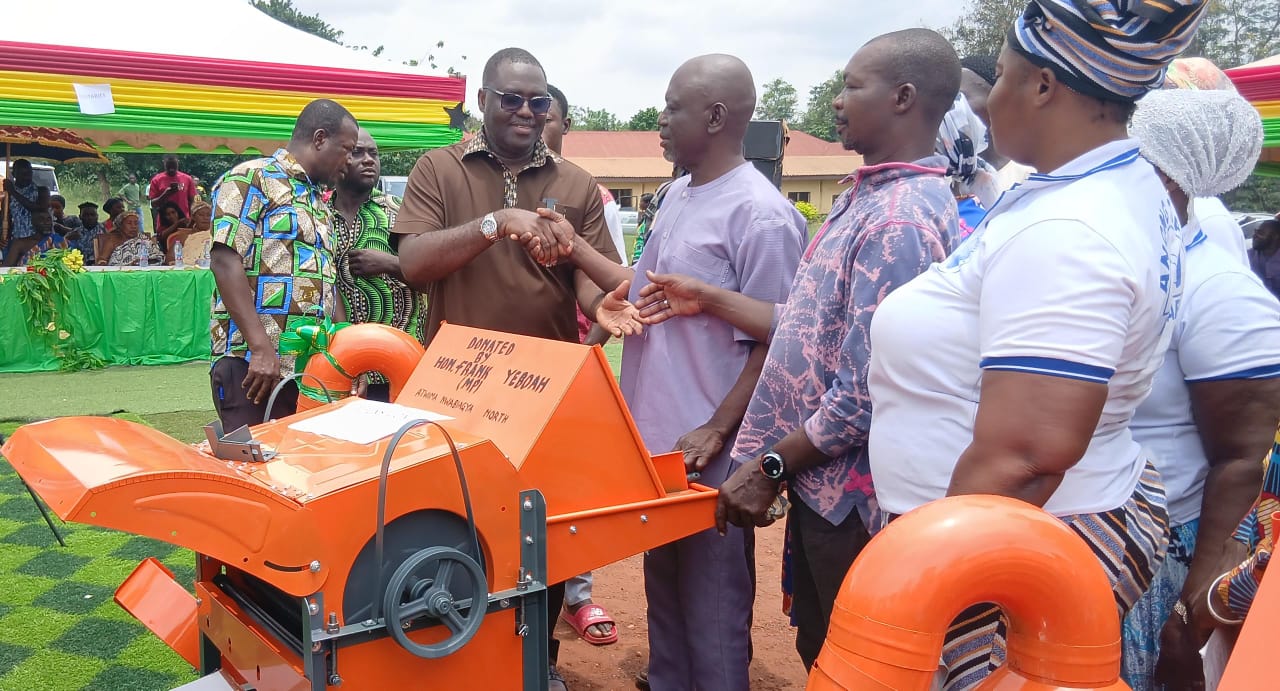
The Member of Parliament for Atwima Nwabiagya North in the Ashanti Region, Hon. Frank Yeboah, has distributed rice threshers and husker machines to six farming groups across the constituency to address persistent post-harvest losses and improve the quality of locally produced grain.
The initiative aims to transition smallholder rice farmers away from traditional, labour-intensive threshing methods, which often lead to high rates of crop degradation and foreign contamination.
Speaking during the handover ceremony at Marbang, Mr Yeboah emphasised that the donation fulfils a core campaign commitment to address practical challenges facing his constituents.
”I made a promise to my people that when they vote for me, I’ll make sure that I take their problems to heart and solve the ones I can,” Mr Yeboah said, adding, “Instead of doing it the traditional way where you see stones and sand in the rice after everything is done, this mechanised approach resolves that problem.”
To ensure farmers’ produce is not spoiled and they do not suffer financial losses, the MP added: “We are now appealing to the central government to come to our aid and help secure market access so farmers can sell their produce.”
The intervention comes at a critical time for the Ashanti Region, which ranks among Ghana’s top rice-producing regions.
Despite substantial agricultural potential, local farmers have long struggled with heavy post-harvest losses due to inadequate machinery and delayed field processing.
According to Yaa Pokua, the Ashanti Regional Extension Officer, access to machinery across the entire production chain, from land preparation to post-harvest operations, remains a major bottleneck.
”Mechanisation is a big challenge. Machines like rice threshers and combine harvesters are not common in our region,” Mrs Pokua stated in an interview with Kumasi FM’s Elisha Adarkwah, adding, “Currently, average yields in the Ashanti Region hover around 3.5 tonnes per hectare, but we have the potential to improve to 6 tonnes per hectare, which is vital for national rice self-sufficiency.”
Mrs Pokua highlighted ongoing initiatives under government- and donor-funded projects, including the Inland Valley Rice Project and the Feed Ghana programme, designed to expand irrigation, supply high-quality seeds, and reduce national reliance on imported rice.
She added that the National Food Buffer Stock Company (NAFCO) continues to purchase local rice to feed senior high schools, offering a partial safety net for growers facing market bottlenecks.
Local farmers expressed relief over the donation, noting that manual harvesting and beating have caused severe physical strain and compromised grain quality.
”We used to beg people to help us beat the rice on the floor, which mixed the grain with sand and caused millers to reject it,” explained one beneficiary, stating, “Now that we have these machines, we are filled with joy.”
Another female farmer noted that delays in finding threshing equipment often left harvested rice exposed to heat in the field for up to a week, discolouring the grains and drastically lowering their market value.
Beatrice Animwaa, the District Best Farmer, commended the MP for easing the physical toll on agricultural workers and urged further investment to attract young people to the sector.
”Honourable Frank Yeboah has relieved us of immense stress,” Mrs Animwaa said, highlighting, “Now that he has supported us with threshers, we appeal for rice harvester machines so we can harvest with ease and encourage youth to get involved in farming.”
Have a news tip or a correction regarding this story? Reach out to our editorial desk at newshubgh2026@gmail.com or contact us on 0245975627.