
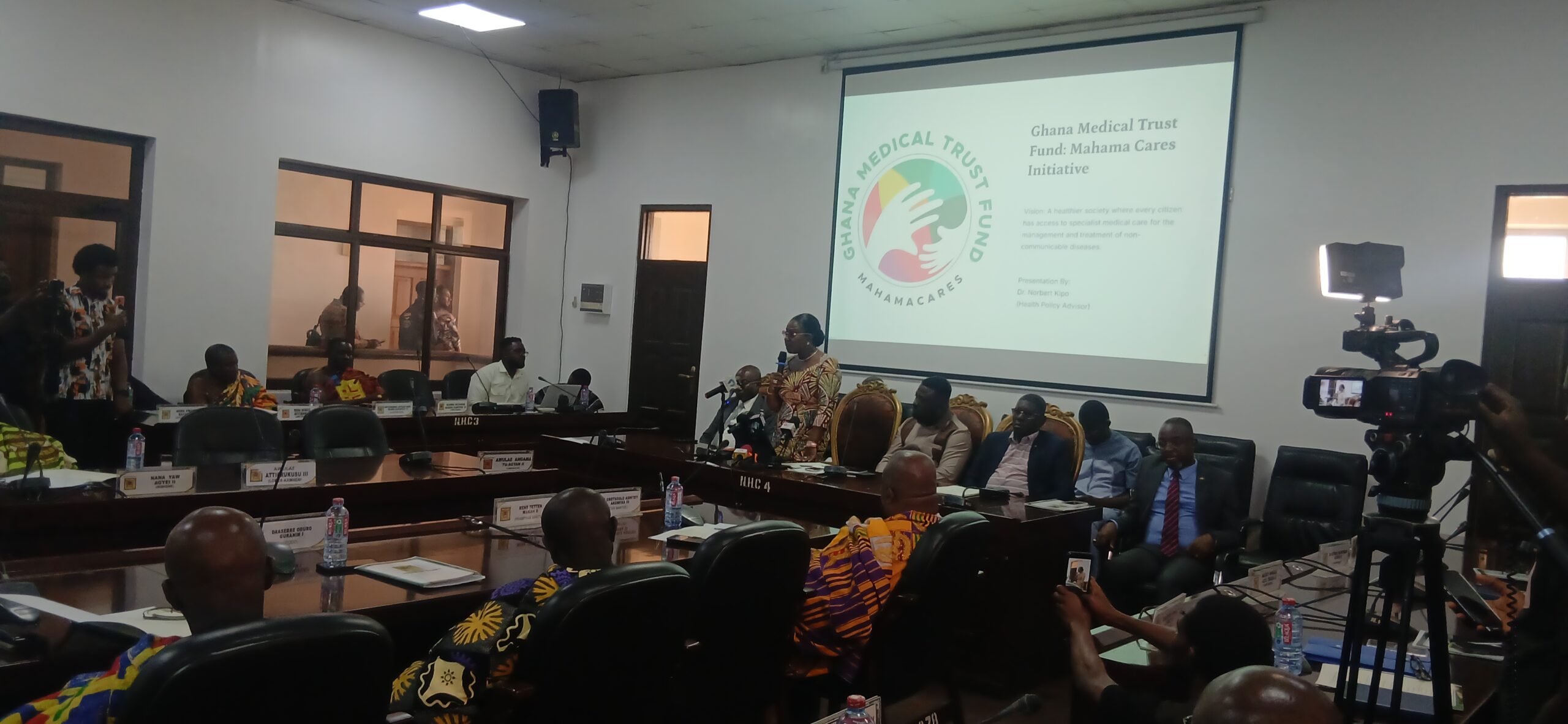
The Administrator of the Ghana Medical Trust Fund, Obuobia Darko-Opoku, has called on the National House of Chiefs to form a strategic partnership to drive community education and create widespread public awareness about the health intervention.
Speaking at a meeting with the National House of Chiefs in Kumasi on Thursday, 2nd July 2026, Darko-Opoku emphasised that the unique leadership and respected voices of chiefs are indispensable to ensuring that ordinary citizens, especially those in rural areas, learn about the fund, popularly known as “Mahama Care.”
She noted that across Ghana, countless families battling chronic non-communicable diseases (NCDs) remain unaware that this vital national support exists, while others are uncertain about who qualifies.
To bridge this communication gap, the fund intends to launch grassroots campaigns, including community town halls and local radio discussions, which she said will gain deep public confidence and cultural relevance through the direct endorsement and involvement of the chiefs.
”Traditional leaders remain among the most trusted authorities within our communities,” Darko-Opoku stated. “When the chiefs speak, the communities listen, and when chiefs champion an important national initiative, people embrace it with trust and confidence.”
The administrator explained that healthcare is one of the greatest investments a nation can make in its people, but noted that a growing burden of chronic conditions—such as kidney diseases requiring dialysis, cancers, stroke, cardiovascular diseases, diabetes, and sickle cell disease—is threatening national productivity.
She highlighted the devastating financial strain these illnesses place on families, forcing many to exhaust their life savings or sell farms and homes just to keep loved ones alive.
To provide a comprehensive strategy against this crisis, she explained that “Mahama Care” is structured around four key pillars: direct financial assistance for patients, investment in critical medical equipment and local health infrastructure, specialised training for healthcare professionals, and funding for targeted medical research.
Updating the House on the fund’s operational progress, Darko-Opoku reported that following the passage of the Ghana Medical Trust Fund Act, a secretariat has been established, a governing board constituted, and a dedicated team recruited.
The fund has already conducted a nationwide assessment tour of healthcare facilities to identify infrastructure gaps, deployed a digital platform to process patient claims transparently, and successfully run pilot beneficiary cases.
As part of its early infrastructure interventions, the fund is also facilitating the establishment of three state-of-the-art cardiac centres at the Korle Bu Teaching Hospital, the Komfo Anokye Teaching Hospital, and the Tamale Teaching Hospital.
Darko-Opoku noted that the ultimate success of the trust fund relies on collective efforts, urging the traditional authorities to counsel management and help mobilise their people so that no eligible Ghanaian is denied quality care due to financial constraints.
In response, Ogyeahoho Yaw Gyebi II, President of the National House of Chiefs, urged traditional leaders—particularly the Presidents of the Regional Houses of Chiefs—to mobilise their communities and raise awareness about the Ghana Medical Trust Fund.
However, Ogyeahoho noted it was unfortunate that the fund’s official operational guidelines had not yet been finalised.
He pointed out that this delay makes it difficult for chiefs to accurately disseminate information and effectively drive the awareness campaign.
Have a news tip or a correction regarding this story? Reach out to our editorial desk at elishaadarkwah@gmail.com or contact us on 0245975627.