
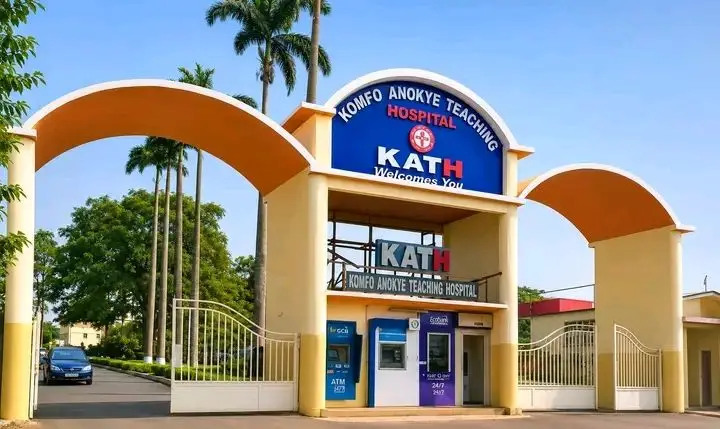
The Minority Caucus in the Parliament of Ghana has strongly condemned the government’s suspension of the Chief Executive Officer of the Komfo Anokye Teaching Hospital (KATH), calling it a “kneejerk” and reactionary decision that fails to address the structural issues plaguing the nation’s health sector.
In a press statement issued on 7th June 2026, signed by Dr Nana Ayew Afriye, MP and Ranking Member on the Committee on Health, the opposition caucus demanded the immediate reinstatement of the KATH CEO pending an independent investigation.
The Minority argued that the severe patient congestion and persistent bed shortages—locally known as “No Bed Syndrome”—are not leadership failures at the hospital level, but rather the result of systemic deficiencies and uncompleted or non-operationalised state infrastructure.
Unoperationalised Hospitals Straining KATH
According to the statement, the overwhelming pressure on KATH is a direct consequence of delayed and abandoned health infrastructure projects across the middle and northern belts of Ghana.
The Minority highlighted several fully or near-completed facilities that were specifically designed to absorb KATH’s excess demand but remain non-operational.
These infrastructure gaps include the 300-bed Ashanti Regional Hospital at Sewua, which comprises a 250-bed regional hospital and a 50-bed Infectious Disease Isolation and Treatment Centre.
Furthermore, the Trede District Hospital and the Kokoben-Oforikrom District Hospital, both 100-bed capacity facilities commissioned in 2024 with state-of-the-art surgical theatres and emergency services, remain largely non-operational nearly two years later.
The opposition questioned whether the lack of urgency in opening the Sewua Hospital is driven by partisan calculations, noting public concerns over whether the Ashanti region is being neglected because it is not considered a major electoral stronghold of the governing NDC.
“Rambo-Style” Leadership Criticised
The caucus sharply criticised the Minister for Health’s approach to management, describing it as a “Rambo-style” method where unilateral actions and public displays of authority have replaced consensus-building and consultation.
“Punishing one hospital administrator may create headlines, but it will not create additional beds, equip emergency wards, recruit specialist staff, or decongest referral centres,” the statement read.
The Minority expressed support for the concerns raised by the Ghana Medical Association (GMA) and the Komfo Anokye Doctors Association regarding due process.
However, they simultaneously urged doctors and health professionals to avoid a prolonged withdrawal of services, warning that industrial action could severely jeopardise life-saving care for patients who rely on KATH.
Calls for Immediate Action
To resolve the impasse and address the root causes of the crisis, the Minority Caucus laid out a series of urgent demands for the government.
They demanded that the government immediately revoke the suspension of the KATH CEO and operationalise all completed health facilities in the Ashanti region, including the Sewua, Trede, and Kokoben-Oforikrom hospitals.
They also urged the Minister for Health to initiate immediate dialogue with the GMA and the KATH Doctors Association to restore normalcy, while shifting away from unilateral actions toward a consultative approach to health sector leadership.